Feral cats and nēnē
Cats reach nēnē two ways. They are direct predators of goslings and incubating adults. They are also the only animal where Toxoplasma gondii can complete its life cycle. The 2024 USFWS 5-year review elevated cat-borne toxoplasmosis to a named threat.
The global context
Free-ranging domestic cats (Felis catus) sit near the top of the list of invasive predators in the modern record. Doherty et al. (2016) put them in the same tier as rats and dogs for documented vertebrate extinctions. The pattern is sharpest on islands, where native species evolved without ground-based mammalian predators.
Hawaiʻi is a textbook case. The only native land mammal before human arrival was the Hawaiian hoary bat. The mammals we now consider ordinary, including cats, mongoose, rats, pigs, goats, and dogs, all arrived on Polynesian and European voyages. Ground-nesting birds had no antipredator behavior to fall back on.
What the global record shows
- • 63 vertebrate extinctions linked to cats (Doherty et al. 2016, PNAS): 40 birds, 21 mammals, 2 reptiles.
- • More than 2,000 species recorded in free-ranging cat diets (Lepczyk et al. 2023, Nature Communications). 16.65% were already of conservation concern.
- • 87 successful eradication campaigns on 83 islands (Campbell et al. 2011, IUCN).
What recovery looks like
Ground-nesting bird populations rebounded measurably after cat removal on Macquarie Island, Wake Atoll, and Klein Curaçao. In Hawaiʻi, the predator-proof fence at Kaʻena Point raised Laysan albatross fledging rates by roughly 25%. Predator-proof fencing is the cleanest available analog for an island-wide eradication when the cat population is too widespread to remove outright.
Cats as predator and disease vector
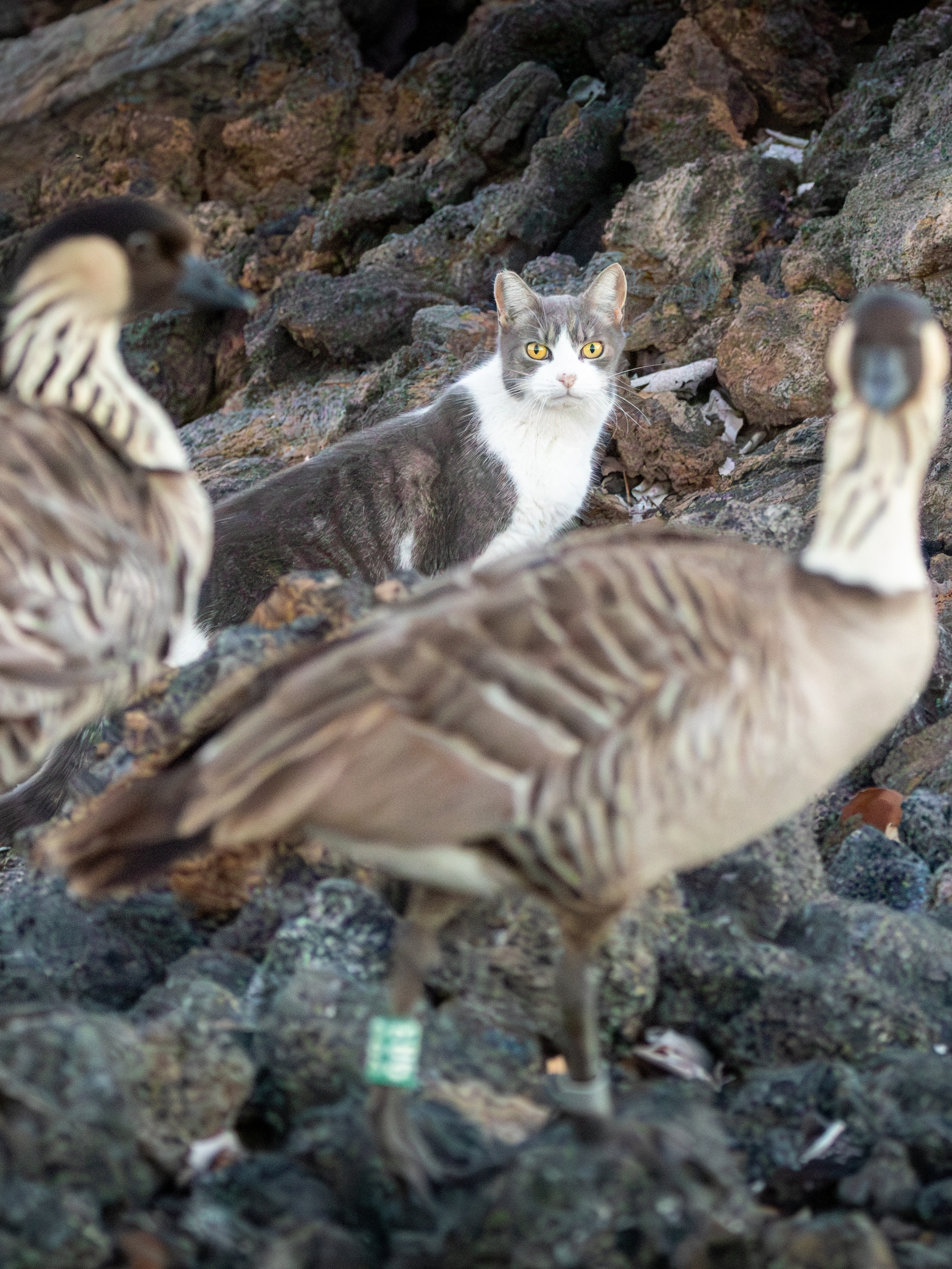
Domestic cats are obligate carnivores that hunt across a wide range of habitats and elevations. On Hawaiʻi Island, Hess et al. (2007, HCSU-010) used radio telemetry to clock male feral cat home ranges at an average of 1,418 hectares, with one individual covering 2,050 hectares. Those are the largest values in the literature. Point-source removal at nesting areas almost never keeps up, because cats recolonize from a large surrounding buffer.
What cats actually eat
Lepczyk et al. (2023, Nature Communications) pulled together cat diet studies from six continents:
- • 2,084 different prey species recorded
- • 347 of those (16.65%) are listed as conservation-concern
- • Island diets contain a higher share of threatened species than continental diets
Extinctions with cats as a documented contributor
Doherty et al. (2016, PNAS) counted modern vertebrate extinctions where cats were a confirmed cause:
HCSU-010, Hawaiʻi Island
Hess and colleagues recovered the mandible, feathers, and bones of an endangered ʻuaʻu (Hawaiian petrel) from one feral cat's stomach contents on Mauna Loa. It was the first well-documented endangered seabird recovered out of a Hawaiian feral cat. Birds turned up in 27.8 to 29.2 percent of the 42 digestive tracts they examined. Those same cats overlap nēnē breeding habitat at every elevation.
Hawaiʻi and nēnē
Nēnē evolved on islands without mammalian ground predators. They nest on the ground in lava fields, pasture, and golf-course edges. Goslings spend several weeks walking before they can fly. Adults are flightless during a four-to-six-week molt. None of those life-history traits work with cats, dogs, mongoose, or pigs in the picture.
A naïve native fauna
Hawaiian plants, birds, and invertebrates evolved without the mammalian herbivores and predators that shape most continental ecosystems. The hoary bat was the only native land mammal before human arrival. Olson and James (1982, 1991) catalogued at least three other Hawaiian goose species in the fossil record. Only nēnē are still here.
Cats arrived on European ships in the late 1700s and went feral on every main Hawaiian island within decades. They reach the alpine and montane elevations where nēnē breed at Haleakalā and Mauna Loa. Statewide cat numbers run into the hundreds of thousands. Precise counts at the island scale are unreliable.
Where the nēnē population stands
By 1949 only about 30 wild nēnē remained, all on Hawaiʻi Island, with roughly a dozen more in captivity (Smith 1952). Captive breeding at Pōhakuloa starting in 1949 and Slimbridge in 1950, then decades of releases, pulled the population back into the thousands. The 2025 NRAG statewide count is 4,323 birds. There is no quantitative pre-1949 estimate. The 25,000 figure that circulated in older popular writing was always explicitly hypothetical (Baldwin 1945).
The 2019 federal rule downlisted nēnē from endangered to threatened. State law (HRS 195D) still classifies the bird as endangered. The species is conservation-reliant. Every population depends on ongoing predator control, biosecurity, and habitat management.
The marine mammal link
T. gondii oocysts shed by cats wash into streams and out to nearshore waters. Hawaiian monk seals and spinner dolphins have both died of toxoplasmosis confirmed on necropsy. NOAA tracks the monk seal cases. Sixteen were confirmed between 2001 and 2026 — a heavy toll on the roughly 380 monk seals in the main Hawaiian Islands, where these deaths occur.
The parasite that reaches the ocean is the same parasite that reaches nēnē on the ground. NOAA: cat-borne toxoplasmosis in Hawaiian marine mammals.
Seabirds share the same cats
Hawaiian petrel (ʻuaʻu) and Newell's shearwater (ʻaʻo) nest in burrows on steep upland slopes. In 2020, DLNR documented a single feral cat killing nine ʻuaʻu chicks across three nights at Hono o Nā Pali on Kauaʻi, captured on trail camera. Tracked petrel chicks have also been killed by cats. The cat populations that hunt seabirds in the uplands are the same cats that take nēnē goslings on the lower slopes.
Cat colonies and food stations
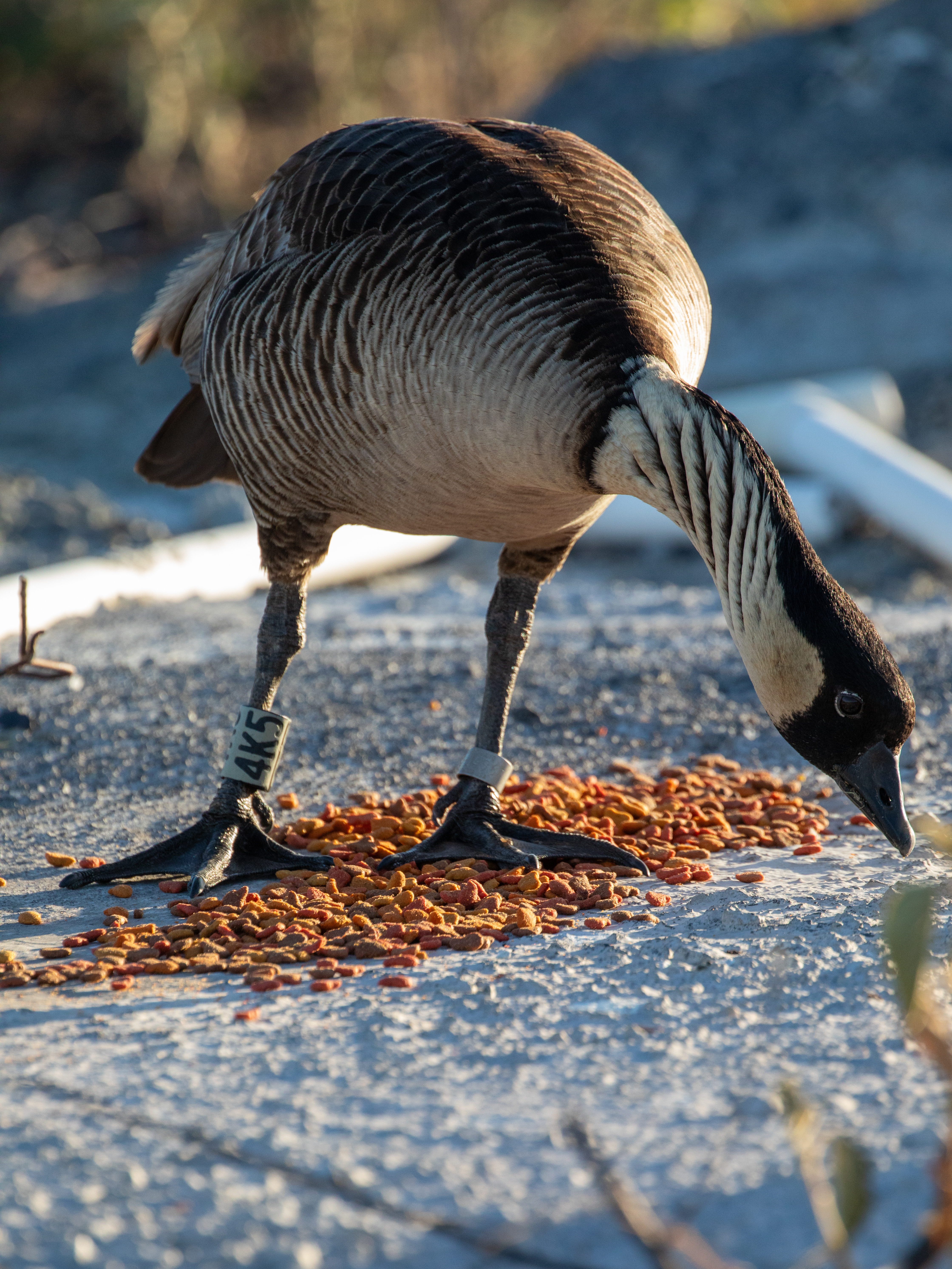
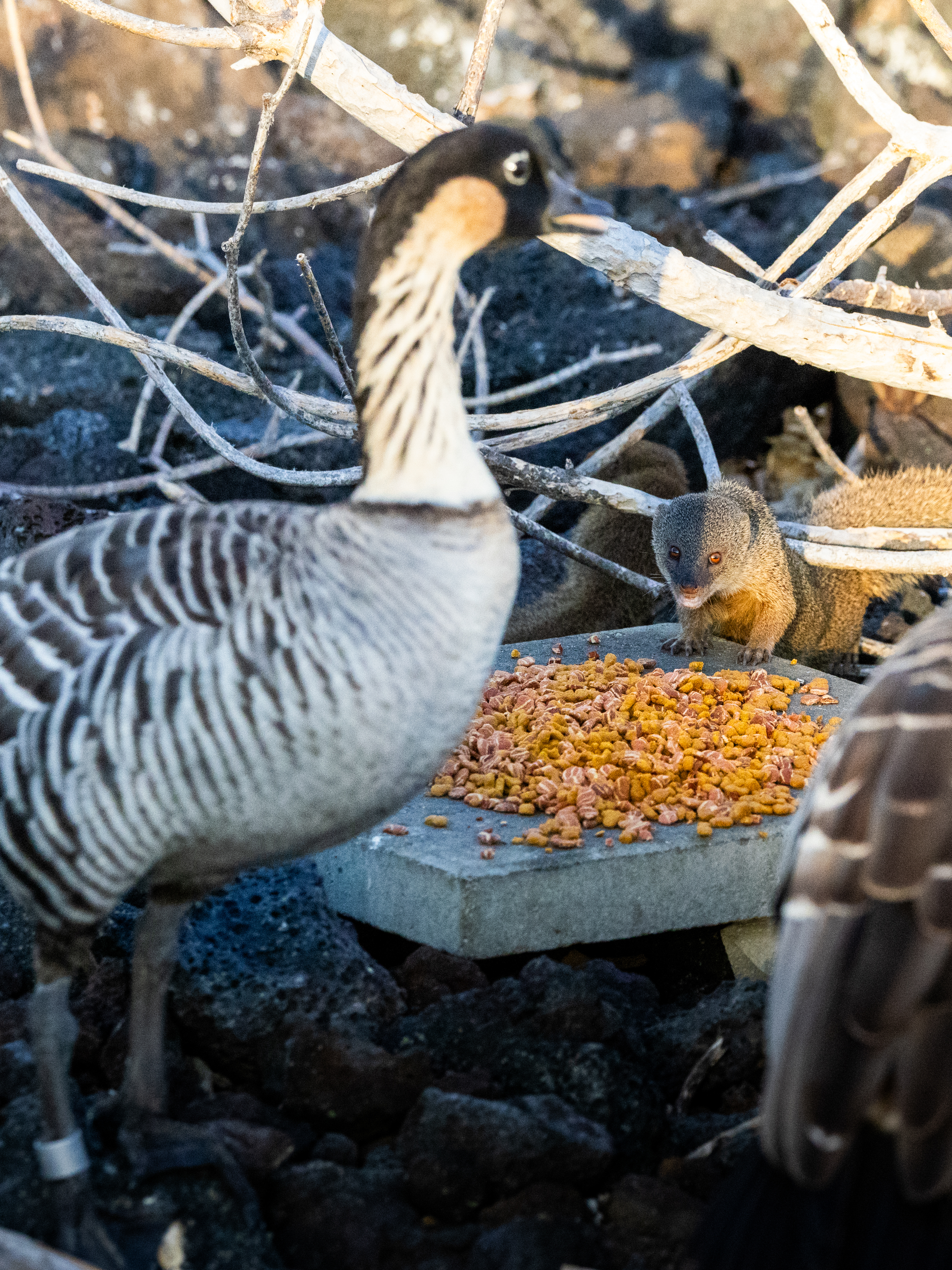
The 2024 USFWS 5-year review names cat colonies (organized feeding sites for feral cats) as an emerging threat. Feeding stations concentrate cats at unnaturally high densities, which means more T. gondii oocysts shed in a small area. Nēnē are opportunistic herbivores and they eat spilled cat food. Cat food is the wrong food for a laying female, and the 2024 review lists poor nutrition from nēnē feeding on it as one of the harms. And these colonies sit in parks, parking lots, and shopping centers right next to roads, pulling nēnē into traffic.
Why feeding stations matter for nēnē
Effects documented in the 2024 5YR, citing State of Hawaiʻi 2023 and the Liliʻuokalani Park gosling case:
- • Cat food pulls nēnē off normal foraging grounds and into urban edges.
- • Higher cat density means a higher oocyst load in the same small area.
- • Cat food does not support egg production. The protein content is wrong for a breeding female.
- • Stations also draw mongoose, rats, and pigs. Feeding one species feeds the whole predator guild.
Documented cases and policy movement
Documented cases in Hawaiʻi
21 red-tailed tropicbirds (6 adults, 15 chicks) killed by feral cats over one weekend near Halona Blowhole, Oʻahu. That site is the only known nesting colony of the species on the island.
A nēnē gosling died of confirmed toxoplasmosis at Liliʻuokalani Park in Hilo. USGS necropsy confirmed T. gondii. The mother, banded NTC, had lost a chick at Wailoa State Park the previous year. The 2024 5YR cites this case as a precedent for state and county action on cat colonies.
One feral cat killed nine endangered ʻuaʻu (Hawaiian petrel) chicks in three nights at Hono o Nā Pali Natural Area Reserve, Kauaʻi. Trail cameras caught the full sequence.
A satellite-tagged ʻuaʻu chick was killed by a feral cat, again on camera. The carcass and tag were recovered. Cats remove research subjects faster than the monitoring programs can account for.
Policy and recovery wins
Hawaiʻi County banned the feeding of feral animals on county property, effective January 1, 2026. The ordinance targets cat colonies in county parks where nēnē and native waterbirds forage. It passed after the 2024 Liliʻuokalani Park gosling death.
DLNR formally ended nēnē feeding at the Queens' Marketplace cat-colony site on Hawaiʻi Island in April 2023. The 2024 5YR points to this as one of the first enforcement precedents tied directly to T. gondii risk to nēnē, citing Work et al. 2016.
Laysan albatross fledging success at Kaʻena Point rose roughly 25% after the predator-proof fence excluded cats, dogs, mongoose, and rats. The same fence design is now in use at Kīlauea Point NWR and several other nēnē-relevant sites.
After cat removal in 2001, breeding seabird pairs on Klein Curaçao climbed from about 140 in 2002 to more than 650. The recovery curve looks like dozens of other post-eradication islands.
Toxoplasmosis in nēnē
Toxoplasma gondii is a protozoan parasite that can only complete its sexual life-cycle stage in the intestines of cats. Nowhere else. Cats shed oocysts in feces. The oocysts contaminate soil, water, and forage. Nēnē are ground-foraging herbivores, so they ingest them. Once in nēnē tissue, the parasite can establish, sometimes lethally.
The 2019 Final Downlisting Rule (84 FR 69926, citing Work et al. 2015) records toxoplasmosis as the most common infectious disease diagnosed in nēnē. Work et al. (2015) reviewed 300 nēnē necropsies from 1992 to 2013 and pinned about 4% of mortalities directly on T. gondii. Work et al. (2016, Journal of Wildlife Diseases) added the seroprevalence picture.
Documented prevalence and impact
- • Kauaʻi nēnē: 21% seropositive (Work et al. 2016, n=42).
- • Maui nēnē: 23% seropositive (n=31).
- • Molokaʻi nēnē: 48% seropositive (n=21). Highest in the survey, on the island where the nēnē population bottomed out at six birds.
- • Mauna Kea feral cats: 37% (25 of 67) seropositive (Danner et al. 2007; Hess et al. 2007 HCSU-010).
- • Road-killed nēnē carry higher T. gondii prevalence than the general population (Work et al. 2016). That fits the Tasmanian pademelon pattern, where subclinical infection seems to impair balance or vision and pushes animals into vehicle strikes.
The rate is going up, and Kauaʻi carries almost all of it
The National Wildlife Health Center's Honolulu field station has necropsied roughly 600 nēnē since 1992. Its March 2026 situation report brings the Work et al. (2015) series forward, and the trend has changed. Toxoplasmosis-positive cases ran mostly under 10 percent of necropsies through the 2010s. In 2025 it was about 26 percent, on the largest annual sample in the record.
- • About 83 percent of all confirmed toxoplasmosis cases are Kauaʻi birds, while Kauaʻi is only about half the necropsies. The cases are concentrated well beyond what the sampling explains.
- • Within Kauaʻi, cases cluster on the north shore: Hanalei, Princeville, and Kīlauea Point National Wildlife Refuge.
- • That is the same north-shore area where ToxoDB genotype #261 was found, and where the island's reintroduced population is densest.
Kauaʻi has no mongoose, which is most of why it holds about 61 percent of the nēnē in the state. It still has cats. Mongoose-free is not predator-free, and cats are the only animal that completes this parasite's life cycle.
Work and colleagues also identified two ToxoDB genotypes (#261, #262) novel to the global database, with geographic segregation on Kauaʻi: #261 in the north, #262 about 40 km south. Hawaiian strains have diverged from continental source populations. That means local cat populations are maintaining the parasite, not constantly re-importing it.
The life cycle, in three steps
1. Sexual stage in cats
Cats are the only animals where T. gondii can reproduce sexually and produce oocysts. Take cats out of the environment and the disease cycle cannot close.
2. Oocyst shedding
A single infected cat can shed hundreds of millions of oocysts over two to three weeks. Most of that shedding happens after the cat's first exposure.
3. Persistence in the environment
Oocysts stay infective in soil and water for two years or more. Once a site is contaminated, removing the cats does not immediately remove the risk.
What reduces cat impact on nēnē
Cat management for nēnē is concrete work. DOFAW, USFWS, and NPS run trapping at HAVO, Haleakalā, Hakalau Forest NWR, Kīlauea Point NWR, and Hanalei NWR. Where breeding sites can be enclosed, predator-proof fencing is the most durable tool. The home-range data from Hess et al. (2007) make it clear that local trapping alone will not hold a site against recolonization. Buffer-scale work, plus cutting the food and habitat subsidies that keep colonies going, is what the evidence supports.
What works on the ground
Predator-proof fencing
Engineered fences that keep cats, dogs, mongoose, and rats out of a defined area. In use at Kīlauea Point NWR, Kaʻena Point, and selected breeding areas at HAVO and Haleakalā.
Trap-and-remove
DOFAW, USFWS, and NPS run cat-trapping in nēnē habitat. The Hess et al. (2007) HCSU-010 report recommends clustering traps near sites that have already caught multiple cats, with a focus on māmane habitat on West Mauna Kea (the identified source population for that island).
Cut the subsidies
Closing cat-feeding stations near nēnē sites brings cat density down and stops pulling nēnē into traffic. Hawaiʻi County's 2026 feeding ban on county property is the first ordinance aimed directly at this mechanism.
Where trap-neuter-return falls short
TNR can stabilize one managed colony over years. That is not the same as solving the issues that matter most for nēnē.
Sterilized cats still hunt
Spay/neuter status does not change a cat's predatory behavior. Goslings and burrow-nesting seabirds are still in range.
Oocyst shedding is unchanged
A neutered cat shedding T. gondii contaminates soil and water exactly like an intact cat. TNR does not break the toxoplasmosis pathway.
Population thresholds rarely hit in practice
Models show sterilization above 75% of the colony is needed for population decline. Field programs almost never reach that, and new abandonment keeps refilling the colony.
Timescale mismatch
Even successful TNR plays out over a cat's natural lifespan, 10 to 15 years. A nēnē population that bottomed out at six birds (Molokaʻi) does not have that window.
What actually helps
If you have a cat
Indoors is the standard of care
- • Keep your cat indoors, or build a catio if outdoor enrichment matters to you.
- • Spay or neuter, and microchip. Deserting a pet animal in Hawaiʻi is illegal under HRS 711-1109.7, a petty misdemeanor.
- • Bag used litter and put it in the trash. Do not flush it. T. gondii oocysts survive municipal wastewater treatment.
- • If your cat does go outside, a brightly colored collar cover reduces (but does not eliminate) bird predation.
If you find an injured nēnē or a feral cat in nēnē habitat
- • Photograph the location and any leg bands you can read.
- • Call DLNR DOFAW or USFWS Pacific Islands.
- • Report the cats on FeralMap so the location lands somewhere a manager will see it.
In the community
Address the colonies
- • Support enforcement of feeding bans on public land, starting with the Hawaiʻi County 2026 ordinance.
- • Back sanctuary placement for adoptable cats instead of re-release at the trap site.
- • Push for cat-free buffers around known nēnē breeding and flocking areas.
- • If you manage a colony near a park or nēnē site, work with DLNR to move the food, not the birds.
Policy
- • Show up to county council meetings when feeding bans are on the agenda.
- • Ask the state to update HRS 195D to clarify cat-colony removal authority.
- • Support the Kauaʻi Mongoose SOP and parallel cat biosecurity work at ports and airports.
- • Read the Civil Beat coverage on how this is playing out locally.
Why this one is tractable
Unlike climate change or historical habitat loss, cat impacts respond fast to local action. The Kaʻena Point fence shifted albatross fledging numbers within two breeding seasons. Wake Atoll seabirds began molting on the atoll again after one cat removal campaign. Kauaʻi's 82% nēnē nest success rests on one historical absence (mongoose) and is defended now by an interdiction protocol that works.
A note from the field
Cat people and nēnē people usually want the same thing: animals not suffering. The honest disagreement is over which animals carry the cost of the current arrangement, and whether that cost falls on a population of 4,323 wild birds or on individual cats whose abandonment is somebody else's violation of state law.
A feeding station next to a nēnē flocking area is a policy choice. It is not an act of compassion, and the choice can be made differently.
References and sources
Last updated May 2026. Claims on this page trace to peer-reviewed publications, USFWS rulemaking documents, and state agency releases.
Nēnē-specific sources
- Work, T.M., et al. (2015). Mortality patterns in endangered Hawaiian geese (Nēnē; Branta sandvicensis). Journal of Wildlife Diseases. 300 necropsies, 1992–2013; T. gondii attributed to ~4% of deaths.
- Work, T.M., Verma, S.K., Su, C., Medeiros, J., Kaiakapu, T., Kwok, O.C., & Dubey, J.P. (2016). Toxoplasma gondii antibody prevalence and two new genotypes of the parasite in endangered Hawaiian geese. Journal of Wildlife Diseases 52(2):253–257.
- Work, T.M. (2026). Situation report for toxoplasma in nēnē necropsied at the National Wildlife Health Center, Honolulu Field Station. USGS, 4 March 2026. Necropsy series 1992–2026; source of the rising-prevalence and Kauaʻi-concentration figures on this page.
- Hess, S.C., Hansen, H., & Banko, P.C. (2007). Reducing feral cat threats to native wildlife in Hawaiʻi. HCSU Technical Report HCSU-010, University of Hawaiʻi at Hilo. 102 pp.
- Danner, R.M., et al. (2007). Feral Cat Toxoplasma exposure, Mauna Kea. Cited in HCSU-010 and 84 FR 69926.
- Lepczyk, C.A., Fantle-Lepczyk, J.E., Misajon, K., Hu, D., & Duffy, D.C. (2019). Long-term history of vehicle collisions on the endangered Nēnē. PLOS ONE 14(2):e0210180.
- U.S. Fish & Wildlife Service. (2019). Final Rule Reclassifying the Nēnē from Endangered to Threatened. 84 FR 69918–69941.
- U.S. Fish & Wildlife Service. (2024). 5-Year Review Short Form Summary: Nēnē or Hawaiian Goose (Branta sandvicensis). Signed August 24, 2024.
- Phillips, R.B., & Lucey, B. (2016). Kauai Mongoose Standard Operating Procedures. USFWS PIFWO / KISC.
Cats as a global driver of vertebrate decline
- Doherty, T.S., et al. (2016). Invasive predators and global biodiversity loss. PNAS 113(40):11261–11265.
- Medina, F.M., et al. (2011). A global review of the impacts of invasive cats on island endangered vertebrates. Global Change Biology 17(11):3503–3510.
- Lepczyk, C.A., et al. (2023). A global synthesis and assessment of free-ranging domestic cat diet. Nature Communications 14:7809.
- Loss, S.R., et al. (2013). The impact of free-ranging domestic cats on wildlife of the United States. Nature Communications 4:1396.
- Campbell, K.J., et al. (2011). A review of feral cat eradication on islands. IUCN, Island Invasives.
Toxoplasmosis biology and Hawaiian marine mammals
- Shapiro, K., et al. (2023). Environmental transmission of Toxoplasma gondii: oocysts in water, soil and food. Food and Waterborne Parasitology.
- UC Davis. Wild and feral cats in populated areas release more toxoplasmosis parasites.
- NOAA Fisheries. Cat-borne toxoplasmosis in Hawaiian monk seals.
- Hawaiʻi DLNR. (2024). Nēnē gosling death from toxoplasmosis at Liliʻuokalani Park, Hilo.
Jump to
At a glance
How cats reach nēnē
Direct predation on goslings and molting adults, plus T. gondii from cat feces
Toxoplasmosis
Most common infectious disease in nēnē. 48% seroprevalence on Molokaʻi (Work et al. 2016).Cat home ranges
Up to 2,050 hectares for one male cat on Hawaiʻi Island (Hess et al. 2007). Local trapping alone cannot hold ground.
What works
Predator-proof fencing, trap-and-remove with a wide enough buffer, and cutting cat-food subsidies near nēnē sites
On this page
- • How cats reach nēnē directly and through T. gondii
- • Documented mortality cases on Hawaiʻi Island, Kauaʻi, and Oʻahu
- • What the Work, Hess, and HCSU studies actually measured
- • Why predator-proof fencing works and TNR does not solve this
- • The 2024 USFWS 5-year review and the elevation of toxoplasmosis to a named threat
Practical next steps
Start here
- • Keep cats indoors or in a catio
- • Bag used litter (do not flush)
- • Push for sanctuary placement over re-release
- • Report cat-food stations near nēnē habitat