Vehicle collisions
Lepczyk pulled 38 years of HAVO road-kill records and found 92 nēnē killed by vehicles. The deaths concentrate on three road segments and peak in November and December. Risk climbs again during the four-to-six-week molt, when adults cannot fly.
The threat
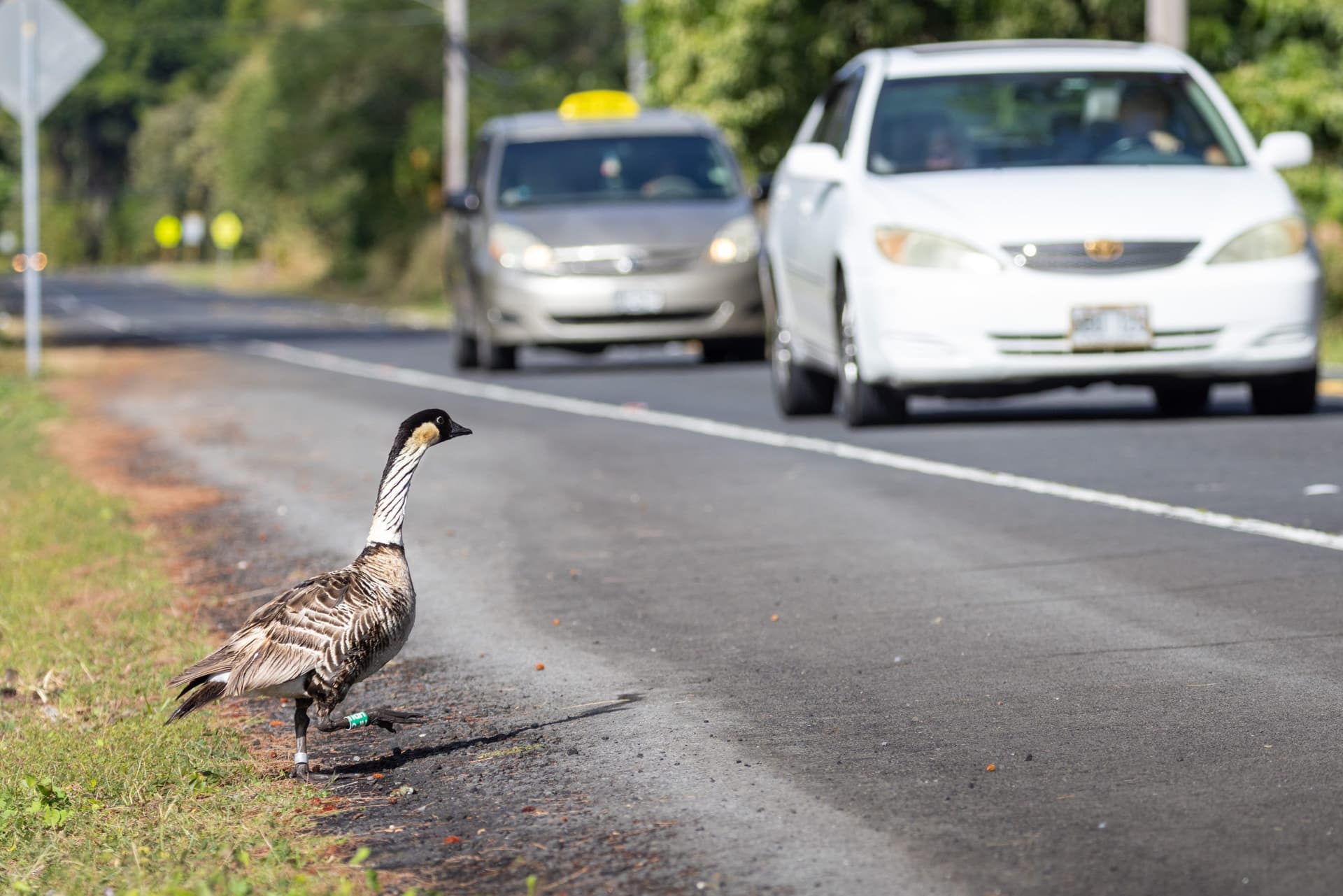
Vehicle strikes are a chronic, additive source of mortality for a long-lived bird with low recruitment. Lepczyk et al. 2019 (PLOS ONE) reviewed 38 years of road-kill records from in and around Hawaiʻi Volcanoes National Park and found 92 nēnē deaths, an average of about 2.4 birds per year. The raw count per year has risen as both the nēnē population and traffic have grown.
The molt window
Adults shed and regrow their flight feathers over four to six weeks each year, usually while their goslings are growing in a first set of flight feathers. The whole family walks through that period.
Why one death cascades
Nēnē pair for life. Lose one adult and the goslings and surviving mate are exposed to predators and traffic for weeks. The brood often fails.
The seasonal signal in Lepczyk's data is strong. December (17 deaths), November (15), and May (13) accounted for most of the mortalities. June was the lowest month at 2. The November–December peak lines up with the start of breeding, when adults move between feeding and nesting areas. May lines up with fledging.
Most strikes cluster on three road segments: Chain of Craters Road between Kīpuka Kāhaliʻi and Muliwai a Pele, the Kaʻū boundary stretch of State Highway 11, and the Nāmakanipaio to Peter Lee segment of Highway 11. About half of the 92 deaths happened outside park boundaries on state highway. Mitigation that stops at the park gate stops halfway.
Per-capita mortality at HAVO has held steady since 1995 even though traffic volume rose about 50 percent over the same period. Segment-level mitigation (fencing, vegetation management, signage, speed enforcement) appears to be doing work that blanket traffic policy cannot.
Current conservation efforts
Lepczyk covered HAVO and nearby roads. Outside the park, the records are scattered across DOFAW, USFWS, NPS, DOT, and county files, and most carcasses never get reported in the first place. The USFWS-facing database holds only eight strike incidents statewide. We are pulling together what we can find from agency files, banding records, and community reports so the next round of mitigation work has a real statewide picture instead of a federal one.
Keaukaha traffic project
In 2023 we started watching a stretch of road in Keaukaha, East Hawaiʻi Island, where several nēnē had been killed by cars. We brought community sightings and vehicle-speed data to the County and DOT. They lowered the posted speed limit on Kalanianaʻole Street and installed speed tables. Project page.
What actually helps
- Slow down through known nēnē areas, especially November through February and again in May. December and November are the two worst months in Lepczyk's 38-year record.
- Do not feed nēnē, and do not feed feral cats near roads. Both pull birds toward pavement and parking lots.
- Treat the molt as a walking season, not a flying one. Adults are flightless for four to six weeks during the breeding and brood-rearing period, roughly September through April on Hawaiʻi Island, and they usually regrow flight feathers about when their goslings grow a first set. The whole family crosses on foot.
- Wildlife fencing along the high-mortality segments is what road-ecology work keeps landing on, and it is what Lepczyk et al. recommend for HAVO. Vegetation management to remove forage grass off the shoulder is already in use on Saddle Road.
- If you find an injured or dead nēnē, photograph the location and call DLNR DOFAW. Banded birds in particular help close gaps in the mortality record.
Press coverage
Keaukaha Speed Limit Change Advances
Nēnē's Death Sparks Call for Action in Keaukaha
State Urges Mindfulness as Endangered Nēnē Face Human Threats
Two Nēnē Killed Near Kahului Airport
Quick facts
HAVO mortality record
92 nēnē killed by vehicles 1977–2014 (Lepczyk et al. 2019); 14% of all mortality 2009–2016
Seasonal peak
November through December, with a smaller second peak in May
Hotspot segments
Chain of Craters Rd (Kīpuka Kāhaliʻi–Muliwai a Pele), Hwy 11 Kaʻū boundary, Hwy 11 Nāmakanipaio–Peter Lee
Report incidents
If you witness a nēnē being struck, or find an injured bird:
Key numbers
- • 92 documented strikes in and near HAVO 1977–2014 (Lepczyk et al. 2019)
- • 50 nēnē killed on Kauaʻi highways 2014–2016 (DLNR)
- • About half of HAVO-area strikes happen outside the park, on state highway
- • Only 8 strike incidents in the USFWS database. The real total is much higher.