Mongoose
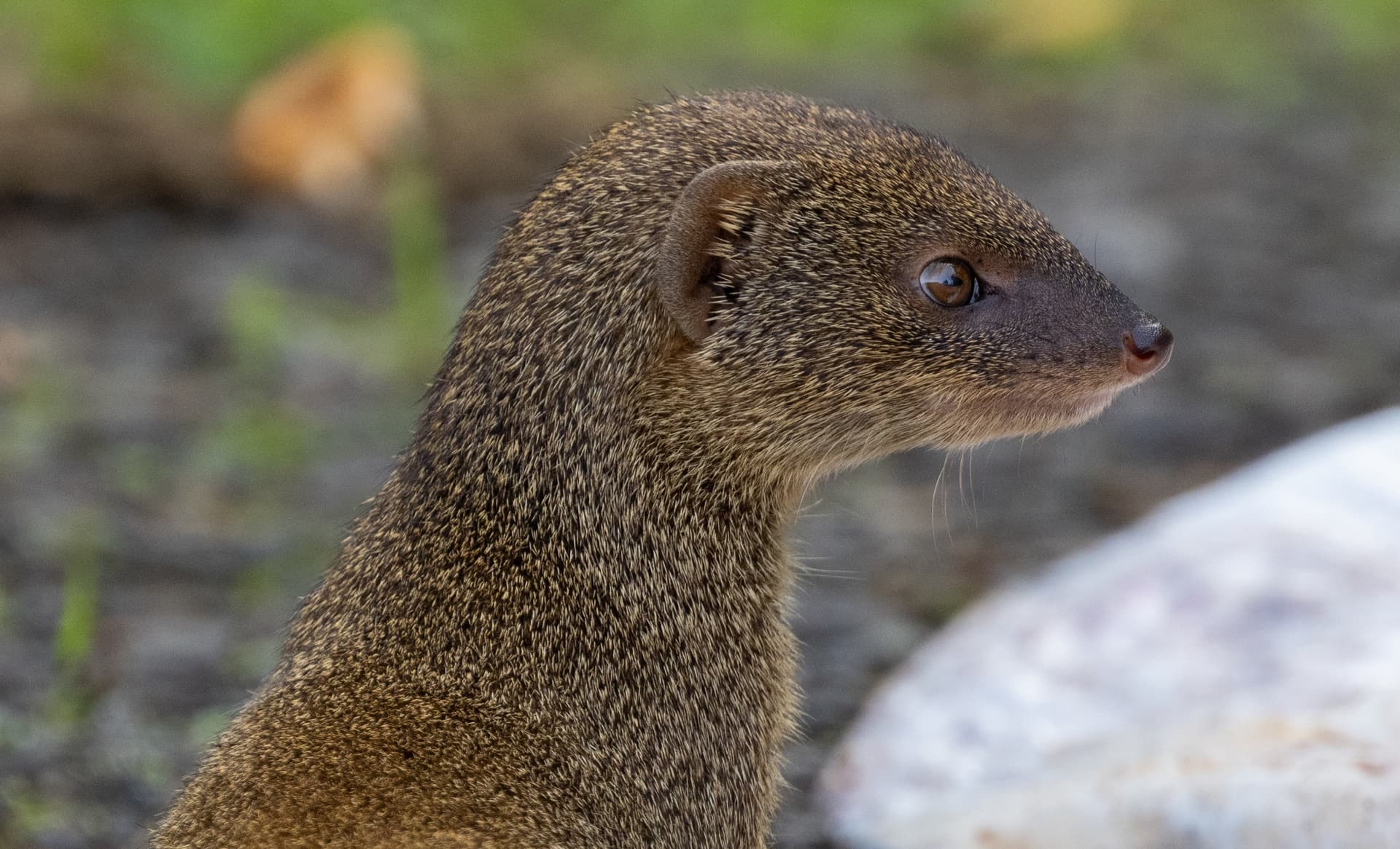
The small Indian mongoose is established on Hawaiʻi Island, Maui, Molokaʻi, and Oʻahu. It never got established on Kauaʻi. Most of what follows is downstream of that.
The threat
Introduced mammals are the proximate reason nēnē almost disappeared, and they still cap breeding success across most of the species' range.
Sugar planters released 72 small Indian mongoose (Herpestes auropunctatus) on the Hilo–Hāmākua coast in 1883, hoping to control rats in cane fields. Within a few decades the animal had moved onto Oʻahu, Molokaʻi, Maui, and Hawaiʻi Island from the shoreline up to about 7,000 ft (2,130 m), which is every elevation nēnē breed at.
Mongoose pull nēnē eggs and goslings out of ground nests. They also take adult birds during the four-to-six-week molt, when nēnē cannot fly. Hoshide 1990, Banko 1992, and Banko & Elder 1990 all named mongoose as the main cause of nest failure on Hawaiʻi Island.
The 2019 final downlisting rule (84 FR 69933) reported nest success of 82 percent on the Kauaʻi NWR Complex, against 62 percent at Haleakalā NP and 58 percent at Hawaiʻi Volcanoes NP (Hu in Banko et al. 1999; Bailey & Tamayose 2016; Uyehara 2016a). Fledglings per successful pair on Kauaʻi came in around 1.44, compared with 0.29 at HAVO. The rule attributed the gap mostly to the absence of mongoose on Kauaʻi.
At the 2025 NRAG count, Kauaʻi held roughly 2,643 of the 4,323 nēnē statewide. Maui fell from 627 in 2017 to 338 in 2022 before recovering to 580 in 2025. Molokaʻi holds about 30 birds.
Mongoose-free is not predator-free. Kauaʻi still has cats, and it is where almost all the nēnē toxoplasmosis is: about 83 percent of confirmed cases in the National Wildlife Health Center's necropsy record, clustered on the north shore around Hanalei, Princeville, and Kīlauea Point. The rate across all islands rose to about 26 percent of necropsies in 2025. Keeping mongoose off the island bought a population. It did not buy immunity from everything else. More on cats and toxoplasmosis.
Why Kauaʻi stayed mongoose-free
Tomich (1986) records that a separate mongoose shipment intended for Kauaʻi was thrown overboard in the harbor by dock workers who recognized the cargo. No documented follow-up introduction ever made it ashore. That one act of dock-worker refusal is the reason roughly 61 percent of living nēnē now hatch on a single island.
Mongoose still turn up on Kauaʻi occasionally. The 2019 rule cites roughly 350 sightings since 1968, plus four confirmed captures around Līhuʻe Airport and Nāwiliwili Harbor in 2012 and 2016, but no breeding population. What keeps the status defensible is operational: the Kauaʻi Mongoose Standard Operating Procedures (Phillips & Lucey 2016) run tracking-tunnel surveys at more than 500 points and trigger a kill-trap rapid response whenever three sightings land inside a half-kilometer radius within two weeks.
Current conservation efforts
87%
of 2023 donations went to predator control in nēnē and waterbird habitat.
1,131
mongoose removed by carcass count. The real number is higher. Traps in remote terrain are not always recoverable.
Trapping rotates between body-grip kill traps for mongoose and live traps that need a daily check. The limiting factor on most lines is volunteer trap-checkers. The 2024 5-year review specifically recommends a Kauaʻi mongoose prevention and interdiction program, so port-side detection and biosecurity work matter as much as trap counts in the back country. If you want to help check lines on Hawaiʻi Island or Maui, write to us.
Regulations
Hawaiʻi Injurious Wildlife (HAR 124)
State law makes it illegal to introduce, keep, or breed mongoose without a Department of Agriculture permit. No permits are issued for Kauaʻi County or for the island of Lānaʻi.
A common misconception
People sometimes describe the mongoose release as a biocontrol effort that went wrong. It was not biocontrol at all. Sugar planters released the animals on their own, without testing diet, range, or non-target impacts. The mongoose preferred ground-nesting birds and reptiles over rats from the start. Calling it biocontrol gives the introduction more legitimacy than it ever had. It was an industry decision, not a scientific program.
Quick facts
How they reach nēnē
Predation on eggs, goslings, and molting adults
Where they are
Established on Hawaiʻi Island, Maui, Molokaʻi, and Oʻahu. Not established on Kauaʻi or Lānaʻi.
Introduction
September 30, 1883, Hilo–Hāmākua coast (Tomich 1986)